
Why Everyone Prefer Imported Plastic Injection Moulding Machine in 2026
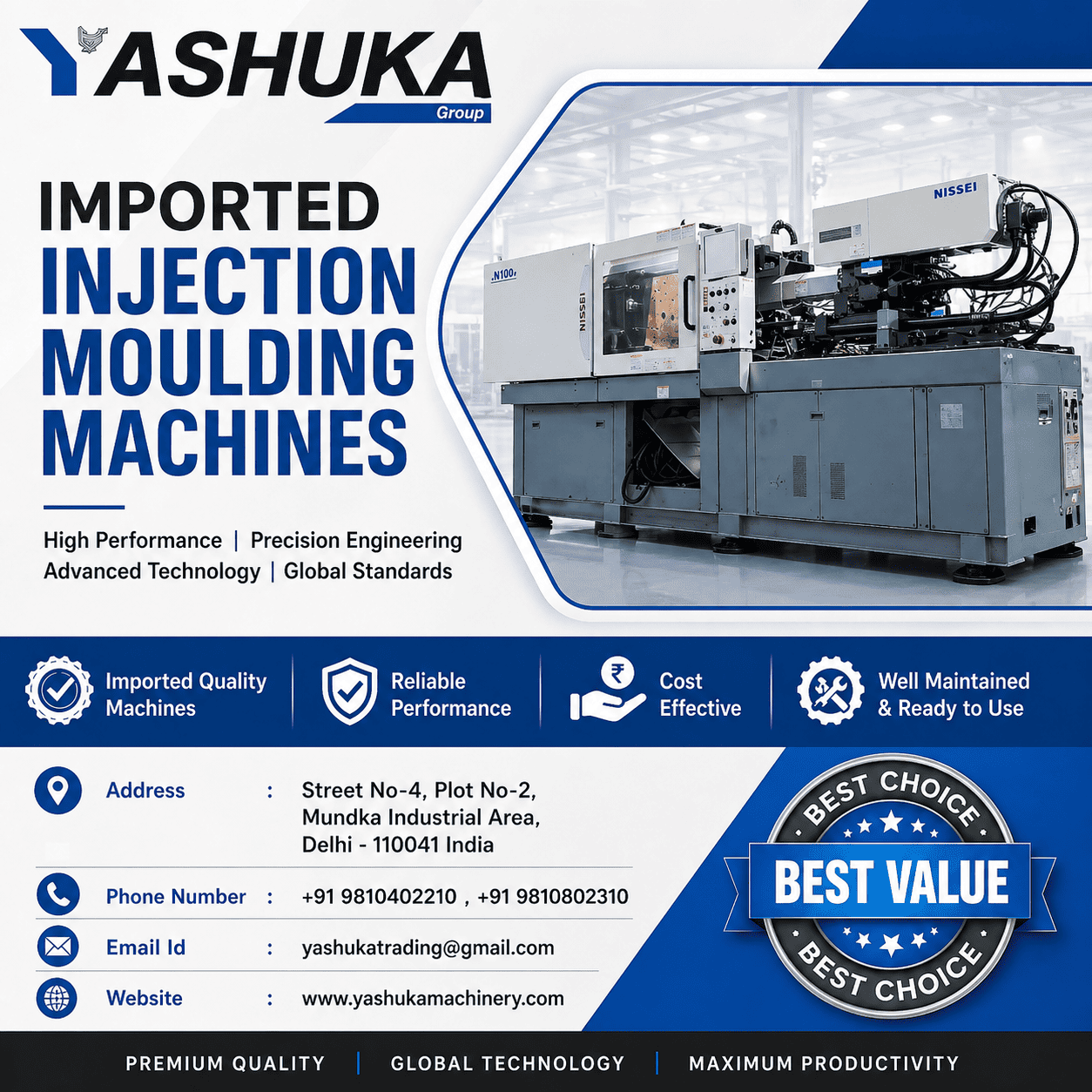
Why Everyone Prefer Imported Plastic Injection Moulding Machine in 2026
Shop Imported Plastic Injection Moulding Machine At Best Price in Delhi — Yashuka Machinery
If you run a plastic manufacturing unit in India and you are looking for a reliable, cost-effective production solution, an imported plastic injection moulding machine is one of the smartest investments you can make. Whether you are setting up a new production line or expanding an existing one, imported machines — especially refurbished ones from trusted sources — give you international-grade performance at a fraction of the cost of buying new.
Yashuka Machinery has supplied refurbished injection moulding machines and auxiliary equipment across India since 2012. We work directly with manufacturers, importers, and second-hand plastic injection moulding machine traders to source machines that meet Indian production demands. Every machine we supply goes through a thorough inspection before it reaches you.
This guide covers everything you need to know before you buy — from how these machines work to which brands dominate the Indian market, what the real price range looks like, and how to avoid costly mistakes during purchase.
What Is an Imported Plastic Injection Moulding Machine?
An imported plastic injection moulding machine is a manufacturing unit originally produced in a foreign country — typically Japan, Germany, South Korea, Taiwan, or China — and brought into India either brand new or as a refurbished/used unit.
These machines inject molten plastic material into a mould cavity under high pressure. Once the plastic cools and solidifies, it takes the exact shape of the mould. This process produces consistent, high-quality plastic parts at scale.
The term "imported" covers two distinct categories:
Brand new imported machines — Shipped directly from the manufacturer abroad. These carry the latest technology but come at a significantly higher price.
Used or refurbished imported machines — Previously owned machines sourced from overseas factories that upgraded their equipment. These machines often have low working hours and deliver the same output as new at 30–60% lower cost.
Yashuka Machinery specialises in the second category — high-performance refurbished imported injection moulding machines — making international-grade equipment accessible to small and mid-sized Indian manufacturers.
Key Features of Imported Plastic Injection Moulding Machines
When you evaluate an imported machine, these are the technical features that define its performance and longevity:
Clamping Force Range — Imported machines are available from 50 tonnes to 3,000+ tonnes. Clamping force determines the size and thickness of parts you can produce.
Injection Unit Precision — European and Japanese machines use servo-driven injection systems that deliver accurate shot weight control, reducing material waste.
Hydraulic vs. All-Electric Systems — Many imported machines, especially from Japan and Germany, use all-electric or hybrid drive systems. These consume 30–50% less energy than conventional hydraulic machines.
PLC Control Panel — Premium imported machines from brands like Engel, Sumitomo, and Toshiba use advanced PLC systems with touchscreen interfaces that give you full control over cycle time, temperature, pressure, and speed.
Barrel and Screw Quality — Imported machines use bimetallic-lined barrels and nitrided screws that handle abrasive and engineering-grade materials like glass-filled nylon, PEEK, and polycarbonate.
Shot Weight Capacity — Available in a wide range, from a few grams for small precision parts to several kilograms for automotive and industrial components.
Tie Bar Spacing — Wider tie bar spacing allows for larger mould sizes, giving you flexibility in what you produce.
Cycle Time — Japanese and German machines are engineered for fast, consistent cycles — often 15–30% faster than domestic alternatives — which directly improves your output per shift.
Benefits and Advantages of Imported Plastic Injection Moulding Machines
1. Superior Build Quality Imported machines, even in their used condition, are built to outlast many domestic alternatives. Manufacturers like Engel, Arburg, Fanuc, and Nissei design machines for 15–20 year operational lifespans.
2. Energy Efficiency All-electric and servo-hydraulic imported machines cut power consumption significantly. For a unit running two or three shifts per day, this directly reduces your monthly electricity bill.
3. Precision and Repeatability International machines deliver tighter tolerances — often within ±0.01mm — which is critical for automotive parts, medical components, and electronic housings.
4. Availability of Technology Many imported machines come with features not yet standard in domestic machines — co-injection, gas-assisted moulding, multi-component capability, and intelligent process monitoring.
5. Lower Cost Per Unit Produced Faster cycle times, less material waste, and lower energy use combine to reduce your cost per part — which matters when you are competing for bulk orders.
6. Resale Value Machines from premium international brands hold their resale value better than many domestic alternatives. A well-maintained Sumitomo or Engel machine retains its value for years.
7. Compatibility with Engineering Plastics Imported machines handle high-performance materials — PC, POM, PEEK, glass-filled PA — that require precise temperature and pressure control, making them essential for technical-grade manufacturing.
Where Imported Plastic Injection Moulding Machines Are Used
Imported injection moulding machines are not limited to one sector. They serve a wide range of industries across India:
- Automobile component manufacturing (dashboards, bumpers, door handles, clips)
- Electrical and electronic part production (switches, connectors, sockets, enclosures)
- Packaging industry (caps, closures, containers, thin-wall packaging)
- Medical and pharmaceutical devices (syringes, IV components, lab consumables)
- Consumer goods (toys, kitchen utensils, storage products, personal care packaging)
- Construction hardware (pipe fittings, clamps, fasteners, junction boxes)
- Agriculture (drip irrigation parts, fittings, trays)
Any business that produces plastic parts in volume can use an imported injection moulding machine to improve quality, speed, and consistency.
Best Industries That Benefit from Used Imported Injection Moulding Machines
Used imported injection moulding machines are particularly valuable for businesses that need high-performance output but cannot justify the capital cost of new equipment.
Automobile Ancillary Units — Tier-2 and Tier-3 auto suppliers use refurbished imported machines to meet OEM quality standards at competitive production costs.
Packaging Manufacturers — High-speed imported machines produce thin-wall packaging faster than most domestic options, reducing cycle time and increasing hourly output.
Export-Oriented Manufacturers — Companies exporting to Europe, the US, or Japan often need production records and process documentation. Imported machines with PLC controls make this straightforward.
Small and Medium Enterprises (SMEs) — A refurbished imported machine gives an SME access to technology they could not otherwise afford, levelling the playing field with larger competitors.
Startups in Plastic Manufacturing — Instead of investing ₹60–80 lakhs in a new domestic machine, a startup can acquire a refurbished imported machine with better specifications for ₹15–35 lakhs.
How an Imported Plastic Injection Moulding Machine Works
The injection moulding process has five core stages:
Stage 1 — Clamping The machine closes and locks the mould using hydraulic or electric clamping force. The clamping unit holds the mould shut against the injection pressure that follows.
Stage 2 — Injection Plastic pellets or granules feed from the hopper into a heated barrel. The rotating screw melts the material and pushes it forward. Once the screw reaches the correct position, it injects the molten plastic into the mould cavity at high speed and pressure.
Stage 3 — Dwelling / Packing After injection, the machine maintains pressure on the mould to compensate for material shrinkage as it cools. This stage ensures dimensional accuracy.
Stage 4 — Cooling The mould's cooling channels carry water or coolant to solidify the plastic. Cooling time depends on part thickness and material type.
Stage 5 — Ejection Once the part is solid, the mould opens and ejector pins push the finished part out. The cycle then repeats.
Imported machines automate all five stages with precise PLC control, which means you get consistent parts cycle after cycle without constant manual adjustment.
Why Buy an Imported Plastic Injection Moulding Machine? Why Are They in Demand?
India's plastic processing industry produces over 16 million tonnes of plastic products annually. As domestic demand grows — driven by FMCG, automotive, construction, and healthcare — manufacturers need machines that can keep pace with volume requirements while maintaining quality.
Imported machines address this gap in four ways:
They already have a proven production track record. A machine that ran successfully in a German or Japanese factory for five to eight years has demonstrated its reliability.
They come loaded with technology domestic machines lack. Features like servo drives, closed-loop control, and intelligent process monitoring are standard on imported machines but optional or unavailable on many domestic equivalents.
They suit India's export requirements. Buyers in Europe and the US require consistent part quality and traceability. Imported machines with digital process logs help Indian manufacturers meet these standards.
They cost far less than new machines with equivalent specs. An imported machine with a clamping force of 300 tonnes and all-electric drive can be acquired refurbished for ₹20–35 lakhs, while a comparable new domestic machine may cost ₹45–65 lakhs.
This price-to-performance ratio is why demand among second-hand plastic injection moulding machine traders, dealers, and buyers continues to grow year on year.
Common Machine Types Available as Imported Plastic Injection Moulding Machines
Horizontal Injection Moulding Machines — The standard configuration where the injection axis is horizontal. These are the most widely used and are available in all clamping force ranges.
Vertical Injection Moulding Machines — Used for insert moulding and over-moulding. The vertical clamping axis allows inserts to be placed by gravity, making the process faster and more accurate.
Two-Platen Machines — Offer a larger platen area without increasing machine footprint. Ideal for automotive and large structural components.
All-Electric Injection Moulding Machines — Use servo motors instead of hydraulics for all movements. Japanese brands — Sumitomo, Fanuc, Toshiba — lead this category. These machines are faster, cleaner, and more energy-efficient.
Servo-Hydraulic (Hybrid) Machines — Use a servo-controlled hydraulic pump, delivering energy savings of 30–40% compared to conventional hydraulic machines while retaining hydraulic clamping force.
High-Speed Thin-Wall Machines — Designed for packaging applications. Engel, KraussMaffei, and Fanuc make machines capable of sub-4-second cycle times.
Micro Injection Moulding Machines — For precision components with shot weights below 1 gram. Used in medical device and electronics manufacturing.
Multi-Component / Two-Shot Machines — Produce parts with two different materials or colours in a single cycle. Engel, Arburg, and Boy are common brands in this segment.
How Imported Plastic Injection Moulding Machines Can Boost Small Manufacturing Businesses
For a small manufacturer, acquiring an imported injection moulding machine — particularly a refurbished one — can change the economics of their business.
Access to better-quality customers — Many large OEMs and export buyers require production from machines with documented process control. An imported machine with a PLC and digital process logs opens doors to these clients.
Lower rejection rates — Imported machines maintain tighter tolerances. When your rejection rate drops from 3% to 0.5%, the material savings alone can recover the machine cost within months.
Reduced downtime — Quality machines from established international brands are built to run with minimal unplanned stops. Their parts are also available through established supplier networks in India.
Competitive pricing on bulk orders — Faster cycle times and lower energy costs let you quote more competitively on large orders without sacrificing margin.
Scalability — A refurbished imported machine gives you the capacity to take on larger order volumes without committing to the capital cost of new equipment.
At Yashuka Machinery, we have seen small businesses in Delhi, Haryana, Rajasthan, and Gujarat transform their production capabilities after switching to refurbished imported machines. The difference shows in their output quality, order size, and client roster.
Why Indian Manufacturers Trust Imported Plastic Injection Moulding Machines
Indian manufacturers — especially those in the auto ancillary, packaging, and electrical sectors — have been buying imported machines for decades, and for consistent reasons:
Longevity — A Japanese or German machine built in 2010 often still outperforms many domestic machines built this decade.
Spare parts availability — Major imported brands have authorised service networks and spare parts distributors across India, particularly in industrial clusters like Pune, Chennai, Ahmedabad, Delhi-NCR, and Ludhiana.
Operator familiarity — As imported machines have become common in Indian factories, experienced machine operators and technicians now know how to run and maintain them.
Financing options — Banks and NBFCs in India now finance used imported machines, treating them as legitimate capital assets, which makes acquisition easier for SMEs.
Quality certification support — Manufacturers seeking ISO, IATF, or export certifications benefit from the process control and documentation features built into imported machines.
Top Brands That Offer Imported Plastic Injection Moulding Machines in India
These are the brands most commonly found on the Indian used and refurbished market, with a note on what each is known for:
Engel (Austria) — Industry leader in precision and all-electric machines. Widely used in automotive and medical sectors.
Arburg (Germany) — Known for versatility and precision. Their Allrounder series covers everything from micro moulding to large-tonnage production.
KraussMaffei (Germany) — Strong in large-tonnage hydraulic and multi-component machines. Common in automotive and construction parts manufacturing.
Fanuc (Japan) — Arguably the benchmark for all-electric injection moulding. Extremely precise, energy-efficient, and low-maintenance.
Sumitomo (Japan) — Known for direct-drive all-electric machines with very fast cycle times. Popular in packaging and electronics.
Toshiba (Japan) — Reliable hydraulic and electric machines with a long track record in Indian factories.
Nissei (Japan) — Compact, efficient machines suited to precision parts. Used widely in electronics and medical device manufacturing.
Demag (Germany/Netherlands) — Robust machines with strong service support in India. Popular in general-purpose plastic manufacturing.
Haitian (China) — Among the most widely sold imported machines in India by volume. Cost-effective with solid build quality for standard production.
Chen Hsong (Hong Kong/China) — Well established in India, particularly for mid-tonnage machines in packaging and consumer goods.
Husky (Canada) — Dominates PET preform and hot runner moulding applications.
Top Exporting Countries and Where to Buy Imported Plastic Injection Moulding Machines
Japan — Supplies the largest volume of used high-quality all-electric and servo-hydraulic machines. Machines from Japan typically have low running hours and are exceptionally well-maintained.
Germany — Source of heavy-duty, large-tonnage machines. German machines are favoured for automotive, construction, and technical parts.
South Korea — LG, Woojin, and Loci machines offer good performance at lower price points than Japanese or German equivalents.
Taiwan — Victor Taichung, Fu Chun Shin, and Multiplas machines are widely used in Indian SMEs for general-purpose moulding.
China — Haitian, Chen Hsong, and HaiTian are common. Cost is the advantage; suitable for standard production work.
USA and Canada — Husky machines for PET preforms; Van Dorn and Cincinnati Milacron for large-tonnage applications.
Where to buy in India: Established dealers and suppliers like Yashuka Machinery source machines directly from overseas factories, auction houses, and industrial liquidations. We handle import documentation, customs clearance, and pre-dispatch inspection — so the machine you receive is ready to install and run.
Why Everyone Prefers Used Japanese Injection Moulding Machines: Why They Are in High Demand
Japanese injection moulding machines have built a reputation that no other country's machines quite match — and the used market proves it. Brands like Fanuc, Sumitomo, Toshiba, and Nissei are engineered to run for 15 to 20 years with minimal breakdown, which means a 10-year-old Japanese machine still delivers output quality and consistency that rivals many new domestic alternatives. Japanese manufacturers design their machines to exceptionally tight tolerances, and that precision carries through decades of production. The all-electric and servo-hydraulic drive systems found in most Japanese machines consume 30 to 50 percent less power than conventional hydraulic machines — a saving that adds up fast for any unit running two or three shifts daily. Indian manufacturers in the automotive, packaging, electronics, and medical sectors specifically seek out used Japanese machines because they handle engineering-grade plastics like polycarbonate, glass-filled nylon, and PEEK without the process instability that lesser machines produce. The PLC control systems on Fanuc and Sumitomo machines are also known for their reliability and ease of use, which reduces operator errors and training time on the shop floor.
The demand for used Japanese injection moulding machines in India has grown steadily because they offer something rare — high performance at a price that SMEs can actually afford. A refurbished Fanuc or Sumitomo machine with a clamping force of 200 to 300 tonnes can be acquired for 40 to 60 percent less than a comparable new machine, without sacrificing cycle speed, repeatability, or energy efficiency. Spare parts and service support for major Japanese brands are now available across India's industrial hubs, which removes the after-purchase risk that once made buyers hesitant. For any manufacturer who wants international-grade production output without the capital burden of buying new, a used Japanese injection moulding machine remains the single most practical choice in today's market.
Maintenance Tips for Imported Plastic Injection Moulding Machines
Proper maintenance directly determines the lifespan and performance of your machine. Follow these practices:
Hydraulic oil — Check oil level and quality weekly. Change hydraulic oil every 2,000–3,000 operating hours or as specified in the machine manual. Contaminated hydraulic oil is the leading cause of pump failure.
Barrel and screw inspection — Inspect the screw and barrel every 6 months for wear. A worn screw reduces shot consistency and increases material waste.
Mould clamping unit — Lubricate tie bars and mould platens regularly. Check clamping force calibration quarterly.
PLC and electrical systems — Inspect electrical connections annually. Check for loose wiring, corrosion on terminals, and deterioration of sensors.
Cooling system — Flush cooling water circuits every 6 months to prevent scaling and blockages. Check water temperature regulation.
Hopper and feed system — Clean the hopper after each material changeover. Ensure the hopper dryer (if fitted) maintains correct drying temperature and dew point.
Belt and gear drives — Inspect drive belts for wear and tension. Replace before they fail, not after.
Grease points — Follow the machine's lubrication schedule. Under-greasing causes premature wear on moving components.
Keep a maintenance log for every machine. If you buy from Yashuka Machinery, we provide the original machine manual (where available) and a maintenance schedule tailored to the machine's age and condition.
Do's and Don'ts — Imported Plastic Injection Moulding Machine
Do's:
- Always run the machine through a warm-up cycle before starting production
- Use the correct material grade and drying specifications for each resin
- Monitor barrel temperature profiles during production and adjust promptly if deviations occur
- Keep spare parts for critical components — seals, sensors, solenoid valves — on hand
- Train operators on the specific PLC interface of the machine they are running
- Record all process parameters for each job to ensure repeatability
Don'ts:
- Do not run the machine cold — always wait for barrel temperatures to stabilise
- Do not force the clamping unit if the machine shows a low pressure alarm
- Do not mix different grades or colours of material without fully purging the barrel
- Do not ignore small oil leaks — they escalate quickly and damage the machine
- Do not attempt electrical repairs without isolating the machine from mains power
- Do not exceed the recommended mould weight for the machine's platen rating
Key Specifications to Check Before Buying
When evaluating an imported machine, these are the specifications that matter most:
| Specification | Why It Matters |
|---|---|
| Clamping Force (tonnes) | Determines the maximum projected area of parts you can mould |
| Injection Pressure (bar) | Higher pressure allows thinner walls and longer flow lengths |
| Shot Weight (grams) | Must match the weight of parts you produce |
| Tie Bar Spacing (mm) | Determines the maximum mould size you can fit |
| Platen Size (mm × mm) | Defines usable mould area |
| Screw Diameter (mm) | Affects plasticising capacity and material shear |
| Cycle Time (seconds) | Directly impacts hourly output and profitability |
| Drive Type | Electric, hydraulic, or hybrid — affects energy cost |
| Control System | PLC brand and software version affects ease of use and spare part availability |
| Year of Manufacture | Indicates likely remaining lifespan and parts availability |
New vs. Imported (Used/Refurbished) Plastic Injection Moulding Machine — Which One to Choose?
This is the question most buyers ask. The answer depends on your production volume, budget, and quality requirements.
Choose a new machine if:
- You have a confirmed long-term production contract that justifies the capital investment
- You need full manufacturer warranty and after-sales support
- You produce medical or pharmaceutical parts where traceable provenance is mandatory
- Your production runs require machine configurations not available in the used market
Choose a refurbished imported machine if:
- You are expanding capacity and need to control capital expenditure
- You produce automotive, packaging, electrical, or consumer goods parts
- You want access to higher-specification machines (servo, electric drive, advanced PLC) at a lower price
- You are an SME or startup building your first or second production line
- You need the machine operational quickly and cannot wait for new machine lead times of 8–16 weeks
For most Indian manufacturers, particularly in Delhi-NCR, a refurbished imported machine from a reputable dealer like Yashuka Machinery offers a better return on investment than buying new.
Cost comparison (approximate):
| Machine Type | New Price (₹ lakhs) | Refurbished Imported Price (₹ lakhs) |
|---|---|---|
| 100-tonne hydraulic | 20–30 | 6–14 |
| 200-tonne servo-hydraulic | 40–60 | 15–28 |
| 300-tonne all-electric | 70–100 | 22–40 |
| 500-tonne hydraulic | 90–130 | 35–60 |
Prices are indicative and vary based on brand, age, condition, and market availability.
Important Things to Check Before Buying a Used Plastic Injection Moulding Machine
Do not skip this checklist. It protects you from buying a machine that looks good but has hidden problems:
Machine running hours — Lower hours generally means less wear, but this figure can be manipulated. Cross-check running hours with the condition of the barrel, screw, and hydraulic pump.
Oil condition — Take a sample of hydraulic oil and check its colour and viscosity. Dark, dirty oil indicates the machine has not been maintained properly.
Physical inspection of the barrel and screw — Ask for the screw to be pulled so you can measure wear with a bore gauge. A worn screw increases material waste and reduces shot consistency.
Clamping system check — Run the machine and observe clamping and ejection cycles. Listen for unusual noise in the toggle or hydraulic clamping unit.
Hydraulic pump and valves — Check for leaks around the pump, solenoid valves, and hydraulic lines. Ask when the pump seals were last replaced.
Electrical and PLC system — Power up the control panel and check all functions. Look for error codes. Test temperature controllers, sensors, and outputs.
Tie bar condition — Inspect tie bars for straightness and check the threads for damage. Bent or damaged tie bars cause clamping force imbalance.
Mould alignment — Check that the platen faces are parallel. Misaligned platens cause uneven clamping and damage moulds.
Service history — Ask for maintenance records. A machine with a documented service history is a lower risk than one without.
At Yashuka Machinery, every machine we list has already gone through this inspection before we offer it for sale.
Common Mistakes to Avoid When Purchasing Used Equipment
Buying on price alone — The cheapest machine is not always the best value. A machine that costs ₹5 lakhs less but needs ₹8 lakhs in repairs is not a bargain.
Not verifying the seller's credibility — Buy from established second-hand plastic injection moulding machine suppliers and dealers who have a verifiable track record. Ask for references from previous buyers.
Skipping a pre-purchase inspection — Always inspect the machine in person or send a qualified engineer before payment. Do not rely solely on photos and videos.
Ignoring import documentation — If you buy an imported machine, confirm that all customs duties have been paid and that you receive proper GST-compliant purchase documentation.
Not checking spare parts availability — Before buying any machine, confirm that key spare parts — seals, heating bands, sensors, solenoid valves — are available in India from local distributors.
Underestimating installation and commissioning costs — Budget for foundation work, electrical connection, cooling water setup, and commissioning. These costs are real and should factor into your purchase decision.
Common Myths About Imported Plastic Injection Moulding Machines
Myth 1: Imported machines are too old to be reliable.
Reality: Many imported machines on the Indian market are 5–12 years old, which is well within their operational lifespan. A 10-year-old Engel or Fanuc machine, properly maintained, outperforms many newer domestic alternatives.
Myth 2: Spare parts are impossible to find.
Reality: Major imported brands — Engel, Arburg, Fanuc, Sumitomo, Haitian — have authorised distributors and spare parts suppliers in India's major industrial centres. Parts for older machines are also available through specialist importers.
Myth 3: Imported machines are too complex for Indian operators.
Reality: Modern PLC interfaces on imported machines are designed for ease of use. With basic training, operators can run these machines efficiently. The bigger challenge is finding technicians for repairs, which is why buying from a dealer with service support matters.
Myth 4: You cannot get finance for used imported machines.
Reality: Several NBFCs and banks in India now offer term loans and equipment finance for used imported machinery, treating them as legitimate capital assets.
Myth 5: Second-hand machines always need major repairs.
Reality: When sourced from a reputable dealer who inspects and refurbishes machines before sale, you are getting a machine that is ready to run. Yashuka Machinery backs every machine we supply with a condition report and, where applicable, a service warranty.
Imported Plastic Injection Moulding Machine Price in India
Prices vary significantly based on brand, clamping force, drive type, year of manufacture, and condition. Below is a realistic price reference for the Indian market:
50–100 tonne machines — ₹3 lakhs to ₹14 lakhs Used for small components: caps, closures, small electronics housings
100–200 tonne machines — ₹8 lakhs to ₹28 lakhs General purpose — packaging, consumer goods, electrical parts
200–400 tonne machines — ₹18 lakhs to ₹50 lakhs Automotive ancillary, industrial components, furniture
400–800 tonne machines — ₹35 lakhs to ₹90 lakhs Large automotive parts, construction materials, bulk containers
800 tonne and above — ₹70 lakhs to ₹2 crores+ Heavy structural components, large industrial moulding
All-electric and servo-hydraulic machines command a 15–25% premium over comparable conventional hydraulic machines due to their energy savings and precision.
Contact Yashuka Machinery for a current, specific price based on your clamping force requirement, preferred brands, and production application.
Why Choose Yashuka Machinery
Yashuka Machinery is not just another listing platform. We are an active participant in the refurbished machine market — buying, inspecting, reconditioning, and supplying machines to manufacturers across India.
Since 2012, we have supplied injection moulding machines and auxiliary equipment to clients in Delhi-NCR, Haryana, Rajasthan, Punjab, Gujarat, Maharashtra, and beyond.
What sets us apart:
Pre-inspected machines — Every machine we sell is inspected by our in-house team before listing. We do not sell machines we have not physically verified.
Honest condition grading — We tell you what is working, what has been repaired, and what may need attention. No hidden surprises after purchase.
Wide range of brands — We stock machines from Engel, Fanuc, Sumitomo, Haitian, Chen Hsong, LG, Toshiba, Nissei, Demag, and others — giving you genuine choice.
Competitive pricing — As direct importers and dealers, we cut out unnecessary middlemen. The price you get from us reflects the actual market.
After-sale support — We assist with installation, commissioning, and connecting you with the right technician or service partner for your machine.
Documentation support — We provide GST-compliant invoices, machine history documents (where available), and import records for machines we source directly.
Auxiliary equipment — Alongside injection moulding machines, we supply dryers, chillers, temperature controllers, robot arms, conveyor systems, and granulators.
Trusted by manufacturers across India — Our repeat clients and referrals are the best proof of how we work.
Whether you are a first-time buyer looking for your first machine or an established manufacturer expanding capacity, Yashuka Machinery gives you the right machine at the right price with the support you need after purchase.
Frequently Asked Questions
Q1: What is the difference between a second-hand and a refurbished imported machine?
A second-hand machine is sold as-is, with no additional work done before sale. A refurbished machine has been inspected, repaired, and brought back to functional condition before sale. At Yashuka Machinery, we supply refurbished machines, not unvetted second-hand equipment.
Q2: How do I know if an imported machine suits my mould?
Share your mould dimensions (length × width × height), mould weight, and part weight with us. We will identify machines with the correct tie bar spacing, platen size, shot weight, and clamping force for your application.
Q3: Do you supply machines outside Delhi?
Yes. We supply across India. We handle transportation and can assist with customs documentation for international shipments.
Q4: Can I get a trial run before purchase?
For machines in our yard, we can arrange a trial run with your material and mould. For machines sourced on order, we can share video documentation of the machine running.
Q5: What auxiliary equipment do I need with an injection moulding machine?
The core auxiliary equipment includes a mould temperature controller (MTC), dryer or dehumidifier for the resin, chiller or cooling tower, robot arm (optional), and a granulator for regrinding sprues and runners.
Q6: How long does delivery take?
Machines in our stock can be dispatched within 3–7 working days after payment. Machines sourced specifically for you may take 3–6 weeks, depending on sourcing location.
Q7: Do you offer any warranty?
We offer a limited functional warranty on refurbished machines as agreed at the time of purchase. Terms vary by machine condition and model.
Q8: Is GST invoice available?
Yes. We provide GST-compliant invoices for all transactions. This also allows you to claim input tax credit on your purchase.
Q9: What payment terms do you accept?
We accept bank transfer (NEFT/RTGS), and in some cases, we can facilitate financing through our NBFC partners.
Q10: Can you source a specific brand and tonnage I am looking for?
Yes. If we do not have a specific machine in stock, we can source it from our network of importers, dealers, and overseas suppliers. Contact us with your exact requirement.
Contact Yashuka Machinery for Imported Plastic Injection Moulding Machine At the Best Price in Delhi
If you are looking for an imported plastic injection moulding machine — whether it is a specific brand, tonnage, or drive type — talk to us. We source machines directly, inspect them personally, and supply them at competitive prices across India.
Yashuka Machinery India's Trusted Name in Refurbished Injection Moulding Machines & Auxiliary Equipment Since 2012
Location: [Delhi, India] , Call/WhatsApp: [+91 9810402210 , +91 9810802310] Email: [yashukatrading@gmail.com] Website: [www.yashukamachinery.com] Business Hours: Monday to Saturday, 9:30 AM – 6:30 PM
We are active dealers, importers, and suppliers of second-hand plastic injection moulding machines in Delhi. Whether you need a 50-tonne vertical machine for insert moulding or a 500-tonne servo-hydraulic machine for automotive parts, we have the inventory and the sourcing network to meet your requirement.
Call us today for a current price list and machine availability.
Yashuka Machinery — Supplying High-Performance Refurbished Injection Moulding Machines Across India Since 2012.


